Robert W Mcchesney Journalism Democracy and Class Struggle Monthly Review November 2000
 | |
| Editor | John Bellamy Foster |
|---|---|
| Categories | Marxism, socialism, political economy, economics, social scientific discipline, philosophy |
| Frequency | Monthly (double upshot July–August) |
| Publisher | Monthly Review Foundation |
| Yr founded | 1949 |
| Country | United States |
| Based in | New York City |
| Language | English language |
| Website | monthlyreview |
| ISSN | 0027-0520 |
| OCLC | 241373379 |
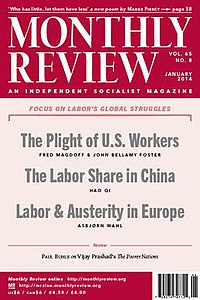
The Monthly Review , established in 1949, is an independent socialist magazine published monthly in New York City. The publication is the longest continuously published socialist mag in the U.s.a..
History [edit]
Establishment [edit]
Following the failure of the contained 1948 Presidential campaign of Henry A. Wallace, two former supporters of the Wallace endeavor met at the farm in New Hampshire where one of them was living. The ii men were literary scholar and Christian socialist F.O. "Matty" Matthiessen and Marxist economist Paul Sweezy, who were former colleagues at Harvard University. Matthiessen came into an inheritance after his father died in an automobile accident in California and had no pressing demand for the coin. Matthiessen made the offer to Sweezy to underwrite "that magazine [Sweezy] and Leo Huberman were always talking near," committing the sum of $five,000 per year for three years. Matthiessen'due south funds fabricated the launch of Monthly Review possible, although the amount of the seed money was reduced to $4,000 per year in the 2nd and third years past the executors of Matthiessen's manor following his suicide in 1950.[1]
Although Matthiessen was the financial angel of the new publication, from the outset the editorial task was handled by Sweezy and his co-thinker, the left wing pop writer Leo Huberman. The author of an array of books and pamphlets during the 1930s and early 1940s, the New York University-educated Huberman worked total-fourth dimension on Monthly Review from its establishment until his death of a heart attack in 1968.[2]
Sweezy and Huberman were complementary figures guiding the publication, with Sweezy'southward theoretical bent and writing ability put to use for a majority of the editorial content, while Huberman took charge of the business and administrative aspects of the enterprise. Sweezy remained at home in New Hampshire, traveling down to New York Urban center once a month to read manuscripts, where Huberman conducted the 24-hour interval-to-mean solar day operations of the magazine forth with his wife, Gerty Huberman, and family unit friend Sybil Huntington May.[iii]
Briefly joining Sweezy and Huberman as a 3rd founding editor of Monthly Review — although non listed as such on the publication'southward masthead — was German language émigré Otto Nathan (1893-1987). Although his fourth dimension of editorial association with the mag was short, Nathan was instrumental in obtaining what would go a seminal essay for the magazine, a lead slice for the debut May 1949 issue by physicist Albert Einstein entitled "Why Socialism?"[5]
Another key contributor during the get-go fifteen years of Monthly Review was economist Paul Baran, frequently considered every bit the third member of an editorial troika including Sweezy and Huberman. A tenured professor at Stanford Academy, Baran was one of a very few cocky-identified Marxists to teach economics at American universities during the Cold State of war period. Baran worked closely with Sweezy on a book regarded as a landmark in Marxist theory entitled Monopoly Capital letter, although he died of a eye attack prior to the piece of work's first publication in 1966.[6]
Monthly Review launched in 1949 with a circulation of just 450 copies, most of whom were personal acquaintances of either Huberman or Sweezy.[7] The magazine'southward ideology and readership closely paralleled that of the independent Marxist weekly newspaper The National Guardian, established in 1948. Despite a conservative political climate in the United states of america, the magazine apace reached a critical mass of subscribers, with its paid circulation rising to 2,500 in 1950 and to 6,000 in 1954.[8]
McCarthy period [edit]
During the era of McCarthyism in the early 1950s, editors Paul Sweezy and Leo Huberman were targeted for "subversive activities". Sweezy's instance, tried by New Hampshire Chaser General, reached the Supreme Court and became a seminal example on freedom of speech when the Court ruled in his favor.[9]
In 1953, the Monthly Review added veteran radical Scott Nearing to the magazine'southward ranks. From that engagement and for virtually xx years Nearing authored a column descriptively entitled "Globe Events". During the Truman and Eisenhower years, many left-wing intellectuals constitute a space for their piece of work in the magazine, including a number that would gain in stature in the ensuing liberalized decade, such as pacifist activist Staughton Lynd (1952), historian William Appleman Williams (1952), and sociologist C. Wright Mills (1958).[ten]
New Left era and after [edit]
From the heart years of the 1960s, radical political theory saw a resurgence in clan with the emergence of a New Left in Europe and North America. Monthly Review grew in stature in tandem with this resurgence.[11] While remaining an intellectual periodical non oriented towards acquiring a mass readership, circulation of the publication nonetheless grew throughout this era, approaching nine,100 in 1970 before peaking at 11,500 in 1977.[12]
While Monthly Review remained essentially a publication with roots in the so-called "Former Left", it was not unsympathetic to the young radical movement which grew in conjunction with the Civil Rights Motion and the opposition to conscription and the Vietnam State of war. Amidst those associated with the 1960s New Left published past the Monthly Review were C. Wright Mills, Herbert Marcuse, Todd Gitlin, Carl Oglesby, David Horowitz, and Noam Chomsky.[12]
The Monthly Review editorial staff was joined in May 1969 by radical economist Harry Magdoff, replacing Leo Huberman, who had died in 1968. Magdoff, a reader of the publication from its first issue in 1949, bolstered the already well-developed "Third-Worldist" orientation of the publication, based upon revolutionary events in Cuba, China, and Vietnam. Sure Maoist influence made itself felt in the content of the publication in this menses.[13]
Monthly Review became steadily more disquisitional of the Soviet Spousal relationship in the 1960s and 1970s, with editor Paul Sweezy objecting to the Soviet invasion of Czechoslovakia in 1968 and the suppression of the Polish trade union "Solidarity" through martial law in 1981.[14] In the latter example, Sweezy declared the incident had proved beyond doubt that "the Communist regimes of the Soviet bloc accept become the expression and the guardians of a new rigidified hierarchical structure which has nothing in common with the kind of socialist order Marxists have ever regarded as the goal of modern working course movements."[15]
Despite an apparent pass up of the American Left in the 1980s, Monthly Review 'southward circulation hovered in the 8,000 range throughout the decade.[16]
Between 1997 and 2000, Monthly Review was co-edited by Ellen Meiksins Forest, Magdoff and Sweezy.
Publication today [edit]
Since 2006, John Bellamy Foster has been the publication's editor. Brett Clark is the associate editor, and the magazine also has one assistant editor and an editorial commission.[17]
Political orientation [edit]
From its showtime consequence, Monthly Review attacked the premise that capitalism was capable of infinite growth through Keynesian macroeconomic fine-tuning. Instead, the magazine's editors and leading writers have remained true to the traditional Marxist perspective that capitalist economies contain internal contradictions which will ultimately pb to their plummet and reconstitution on a new socialist ground. Topics of editorial concern have included poverty, unequal distribution of incomes and wealth.
Although non averse to give-and-take of esoteric matters of socialist theory, Monthly Review was generally characterized by an aversion to doctrinaire citations of Marxist canon in favor of the analysis of existent-world economical and historical trends. Readability was emphasized and the use of academic jargon discouraged.[sixteen]
Editors Huberman and Sweezy argued every bit early as 1952 that massive and expanding armed services spending was an integral part of the procedure of capitalist stabilization, driving corporate profits, bolstering levels of employment, and absorbing surplus production. They argued the illusion of an external military machine threat was required to sustain this organisation of priorities in regime spending; consequently, endeavor was made by the editors to challenge the dominant Common cold War prototype of "Democracy versus Communism" in the material published in the magazine.[xviii]
In its editorial line Monthly Review offered disquisitional support of the Soviet Union during its early years although over time the magazine became increasingly disquisitional of Soviet dedication to Socialism in I Country and peaceful coexistence, seeing that country as playing a more or less conservative office in a world marked by national revolutionary movements. Afterwards the Sino-Soviet split of the 1960s, Sweezy and Huberman soon came to encounter the People'southward Republic of People's republic of china as the actual center of the world revolutionary movement.[19]
Monthly Review never aligned with whatsoever specific revolutionary motility or political system. Many of its articles have been written by academics, journalists, and freelance public intellectuals, including Albert Einstein, Tariq Ali, Isabel Allende, Samir Amin, Julian Bond, Marilyn Buck, Thousand. D. H. Cole, Bernardine Dohrn, W. E. B. Du Bois, Barbara Ehrenreich, Andre Gunder Frank, Eduardo Galeano, Che Guevara, Lorraine Hansberry, Edward S. Herman, Eric Hobsbawm, Michael Klare, Saul Landau, Michael Parenti, Robert W. McChesney, Ralph Miliband, Marge Piercy, Frances Fox Piven, Adrienne Rich, Jean-Paul Sartre, Daniel Singer, E. P. Thompson, Immanuel Wallerstein, and Raymond Williams.[5]
In 2004, Monthly Review editor John Bellamy Foster told The New York Times: "The Monthly Review... was and is Marxist, simply did not hew to the political party line or get into sectarian struggles."[9]
Not-English editions [edit]
In add-on to the U.South.-based mag, in that location are seven sis editions of Monthly Review. They are published in Greece; Turkey; Spain; South korea; also as dissever English language, Hindi, and Bengali editions in India.[20]
Monthly Review Press [edit]
Monthly Review Press, an allied endeavor, was launched in 1951 in response to the disability of the maverick left-fly announcer I. F. Stone to otherwise find a publisher for his book The Hidden History of the Korean State of war. Stone'south piece of work, which argued that the withal ongoing Korean State of war was non a instance of uncomplicated Communist armed forces aggression but was rather the production of political isolation, Southward Korean military buildup, and edge provocations, became the first title offered by the affiliated publisher in 1952.[21]
Harry Braverman (author of Labor and Monopoly Capital)[22] became managing director of Monthly Review Press in 1967. The present director of the Press is Michael D. Yates (author of Naming the Organisation).[23] Monthly Review Press is also the U.S. publisher of The Socialist Register,[24] an annual British publication since 1964, which contains topical essays written past radical academics and activists as was coedited in role past the late Leo Panitch.
Titles published past the printing in its formative years include Nosotros, the People: The Drama of America past Leo Huberman (1932), The Empire of Oil by Harvey O'Connor (1955), The Political Economy of Growth [25] by Paul Baran (1957), Consciencism: Philosophy and Ideology for Decolonization and Development with Detail Reference to the African Revolution by Kwame Nkrumah (1959), Caste, Class and Race by Oliver Cromwell Cox (1948/1959), Capitalism and Underdevelopment in Latin America: Historical Studies of Chile and Brazil by Andre Gunder Frank (1962), The U.s.a., Cuba, and Castro past William Appleman Williams (1963), Anarchism by Daniel Guerin (1965), Fanshen: A Documentary of Revolution in a Chinese Village [26] past William Hinton (1966), Monopoly Capital [27] past Paul A. Baran and Paul 1000. Sweezy (1966), Revolution and Development in the Twentieth Century by James Boggs and Grace Lee Boggs (1969), The National Question: Selected Writings by Rosa Luxemburg (1971), The Poverty of Theory and Other Essays by E. P. Thompson (1973), the English language translation of Open Veins of Latin America [28] by Eduardo Galeano (1973), Puerto Rican Obituary by Pedro Pietri (1973), Unity and Struggle: Speeches and Writings of Amilcar Cabral (1974), Spiks, by Pedro Juan Soto (1974), Unequal Development [29] by Samir Amin (1976), The Arabs in Israel past Sabri Jiryis (1976), On Education: Articles on Educational Theory and Educational activity, and Writings for Children from "The Age of Aureate" by Jose Martí and edited by Eric Foner (1979), The 'Dictatorship of the Proletariat' from Marx to Lenin by Hal Draper (1982), The Poor and the Powerless: Economic Policy and Alter in the Caribbean by Clive Y. Thomas, Columbus: His Enterprise: Exploding the Myth by Hans Koning (1987) and Eurocentrism [xxx] (1989) past Samir Amin.[21]
In later years, Monthly Review Printing has published such titles equally Discourse on Colonialism [31] past Aimé Césaire (1995), Reminiscences of the Cuban Revolutionary War past Che Guevara (1994), Republic of haiti: Land Against Nation by Michel-Rolph Trouillot (1996), The Problem of the Media: U.Due south. Communication Politics in the Twenty-Offset Century by Robert W. McChesney (2000), Toward an Open Tomb: The Crisis of Israeli Society by Michel Warschawski (2000), Biological science nether the Influence [32] by Richard Lewontin and Richard Levins (2007), Walter A. Rodney: A Promise of Revolution by Clairmont Chung (2008), The Great Financial Crisis [33] by Fred Magdoff and John Bellamy Foster (2009), America'due south Didactics Deficit and the War on Youth by Henry A. Giroux (2013), Large Farms Make Big Flu: Dispatches on Infectious disease, Agribusiness, and the Nature of Science by Rob Wallace (2016), Fighting Two Colonialisms: Women in Guinea-bissau by Stephanie J. Urdang (1975/2017), The Dawning of the Apocalypse: The Roots of Slavery, White Supremacy, Settler Colonialism, and Capitalism in the Long Sixteenth Century by Gerald Horne (2020), as well as Marx's Ecology, [34] The Return of Nature and other titles by Monthly Review Magazine editor John Bellamy Foster.
MRzine [edit]
From 2005 to 2016, Monthly Review published an associated website, MRzine. At its closure, Monthly Review announced that it would maintain an online archive of the site.[35]
Abstracting and indexing [edit]
According to the Journal Citation Reports, the journal has a 2014 impact gene of 0.460, ranking it 107th out of 161 journals in the category "Political Science".[36]
Editors [edit]
Monthly Review Magazine has had 6 editors listed on its masthead:[5]
- Paul Sweezy, from 1949 to his expiry in 2004
- Leo Huberman from 1949 to his death in 1968
- Harry Magdoff from 1969 to his death in 2006
- Ellen Meiksins Forest, 1997–2000
- Robert W. McChesney, 2000–2004
- John Bellamy Foster, May 2000–present
Harry Braverman became director of Monthly Review Press in 1967, and the nowadays director of the Printing is Michael D. Yates.
Footnotes [edit]
- ^ C. Phelps (1999). "Introduction: A Socialist Magazine in the American Century". Monthly Review. 51 (1): 1–21. doi:10.14452/MR-051-01-1999-05_1.
- ^ Phelps, C. (1999). "Introduction: A Socialist Mag in the American Century". Monthly Review. 51 (1): 1–21. doi:10.14452/MR-051-01-1999-05_1. p. 3-4
- ^ Savran, S.; Tonak, E. A.; Sweezy, P. M. (1987). "Interview with Paul M. Sweezy". Monthly Review. 38 (eleven): i. doi:10.14452/MR-038-xi-1987-04_1. p. 32-33
- ^ a b c "Nearly Monthly Review".
- ^ Phelps, C. (1999). "Introduction: A Socialist Magazine in the American Century". Monthly Review. 51 (ane): 1–21. doi:10.14452/MR-051-01-1999-05_1. p. 4-5.
- ^ Savran, S.; Tonak, Eastward. A.; Sweezy, P. M. (1987). "Interview with Paul 1000. Sweezy". Monthly Review. 38 (11): 1. doi:x.14452/MR-038-eleven-1987-04_1. p. 43-44
- ^ Phelps, C. (1999). "Introduction: A Socialist Magazine in the American Century". Monthly Review. 51 (1): 1–21. doi:10.14452/MR-051-01-1999-05_1. p. seven-9.
- ^ a b Paul Sweezy, 93, Marxist Publisher and Economist, Dies, The New York Times, March 2, 2004.
- ^ Phelps, C. (1999). "Introduction: A Socialist Magazine in the American Century". Monthly Review. 51 (ane): 1–21. doi:10.14452/MR-051-01-1999-05_1. p. eighteen-19.
- ^ John Bellamy Foster, "Monthly Review," in Mari Jo Buhle, Paul Buhle, and Dan Georgakas (eds.) Encyclopedia of the American Left New York: Garland Publishing Co., 1990; p. 485.
- ^ a b Phelps, C. (1999). "Introduction: A Socialist Mag in the American Century". Monthly Review. 51 (1): 1–21. doi:10.14452/MR-051-01-1999-05_1. p. 20-21.
- ^ Phelps, C.; Magdoff, H. (1999). "Interview with Harry Magdoff". Monthly Review. 51 (ane): 54–73. doi:10.14452/MR-051-01-1999-05_3. p. 54, pp. 61-64
- ^ Phelps, C. (1999). "Introduction: A Socialist Magazine in the American Century". Monthly Review. 51 (1): one–21. doi:10.14452/MR-051-01-1999-05_1. p. 24-25.
- ^ Sweezy, P. One thousand. (1983). "The Suppression of the Smooth Workers Motion". Monthly Review. 34 (eight): 27–30. doi:10.14452/MR-034-08-1983-01_3. p. 30
- ^ a b John Bellamy Foster, "Monthly Review," in Mari Jo Buhle, Paul Buhle, and Dan Georgakas (eds.)Encyclopedia of the American Left. New York: Garland Publishing Co., 1990; p. 484.
- ^ Monthly Review Archives, "Editorial Team."
- ^ Peter Clecak, "Monthly Review (1949—)," in Joseph R. Conlin (ed.), The American Radical Press, 1880-1960: Volume two. Westport, CT: Greenwood Press, 1974; pg. 667.
- ^ Clecak, "Monthly Review (1949—)," p. 671.
- ^ "Foreign Editions of Monthly Review". Archived from the original on 2017-08-18. Retrieved 2013-03-24 .
- ^ a b Phelps, C. (1999). "Introduction: A Socialist Magazine in the American Century". Monthly Review. 51 (1): 1–21. doi:10.14452/MR-051-01-1999-05_1. p. 15-16.
- ^ Braverman, Harry (1998) [1974]. Labor and Monopoly Capital: The Degradation of Work in the Twentieth Century. New York: Monthly Review Press. ISBN0853459401.
- ^ Yates, Michael D. (2003). Naming the System. New York: Monthly Review Printing. ISBN1583670793. OCLC 477201729.
- ^ Panitch, Leo; Albo, Greg; Chibber, Vivek, eds. (2013). Registering class: socialist annals 2014. New York: Monthly Review Printing. pp. 335. ISBN978-1583674314. OCLC 844308930. Too meet the full listing Socialist Register books.
- ^ Baran, Paul A. (2000). The political economic system of growth. New York: Monthly Review Press. ISBN0853450765.
- ^ Hinton, William (2008) [1966]. Fanshen. New York: Monthly Review Press. ISBN978-1583671757.
- ^ Baran, Paul A.; Sweezy, Paul M. (1966). Monopoly Capital: An Essay on the American Economical and Social Order. New York: Monthly Review Press. ISBN0853450730.
- ^ Galeano, Eduardo (1997) [1973]. Open Veins of Latin America: 5 Centuries of the Pillage of a Continent. New York: Monthly Review Press. ISBN9780853459910.
- ^ Amin, Samir (1973). Unequal development. New York: Monthly Review Press. ISBN9780853453802. OCLC 477201729.
- ^ Amin, Samir (2010) [1989]. Eurocentrism (2nd ed.). New York: Monthly Review Press. ISBN9781583672075.
- ^ Césaire, Aimé (2000) [1955]. Soapbox on Colonialism . New York: Monthly Review Printing. ISBN1583670254.
- ^ Lewontin, Richard; Levins, Richard (2007). Biological science Nether the Influence: Dialectical Essays on Ecology, Agronomics, and Health . New York: Monthly Review Press. ISBN9781583671573.
- ^ Magdoff, Fred; Foster, John Bellamy (2009). The Great Financial Crunch: Causes and Consequences. New York: Monthly Review Press. ISBN9781583671849.
- ^ Foster, John Bellamy (2000). Marx'south Ecology: Materialism and Nature. New York: Monthly Review Press. ISBN1583670122.
- ^ "MR'due south Upgrade". Monthly Review. Dec 31, 2016. Retrieved Jan 8, 2017.
- ^ "Journals Ranked by Bear on: Political Science". 2014 Journal Citation Reports. Spider web of Science (Social Sciences ed.). Thomson Reuters. 2015.
Further reading [edit]
- Paul A. Baran, The Longer View. New York: Monthly Review Press, 1969.
- Stephen Resnick and Richard Wolff, Rethinking Marxism: Essays for Harry Madgoff and Paul Sweezy. Brooklyn, NY: Audomedia, 1985.
- Savran, South.; Tonak, E. A.; Sweezy, P. Thou. (1987). "Interview with Paul M. Sweezy". Monthly Review. 38 (11): ane. doi:10.14452/MR-038-11-1987-04_1.
- "From the Left: Harry Magdoff; A Free-Market Failure," New York Times, Nov 1, 1987.
- Robert West. McChesney, "The Monthly Review Story: 1949-1984," MRzine, June 5, 2007.
- Attewell, Paul A. (1984). Radical political economy since the sixties: a folklore of cognition analysis. New Brunswick, N.J.: Rutgers Academy Press. ISBN0813510538. OCLC 10230097.
External links [edit]
- Official website

- Monthly Review Press: publishing house and itemize
- Monthly Review Press titles nevertheless in print
- Monthly Review Archives
Source: https://en.wikipedia.org/wiki/Monthly_Review
0 Response to "Robert W Mcchesney Journalism Democracy and Class Struggle Monthly Review November 2000"
Post a Comment